Coffee Talk: Managing Coffee for Events & Conferences
Learn how to accurately estimate coffee quantities for conferences. Discover effective strategies to manage coffee consumption, budgeting tips, and best practices for ensuring your event runs smoothly without exceeding your budget.
Gregory Perrine · Jun 25, 2024 · 4 min read
Guests, hours and refresh period in. Gallons of regular, decaf and hot water, plus sodas and water, out.
Coffee is an essential part of any conference, often making up a significant portion of the budget. At the last conference we planned, coffee accounted for more than 10% of the total budget, translating to over 150,000 cups of coffee. With the price of a gallon of coffee often exceeding $100 at many properties, managing this budget line item can mean the difference between staying within budget and overspending significantly.
Run your own numbers first, then read on for where they come from.
Free tool
Coffee & beverage calculator
Guests, the service window and how often the venue refreshes. The estimate updates as you type.
Adjust the mix
15 cups to a gallon, the article’s buffer on an 8 oz cup.
3 sets over 9 hours · 8:00 AM · 11:00 AM · 2:00 PM
| Beverage | Per set | Total |
|---|---|---|
| Regular coffee70% of 500 cups | 24 gal | 72 gal |
| Decaf coffee20% | 7 gal | 21 gal |
| Hot water for tea10% | 4 gal | 12 gal |
| Sodas60% of the cold beverages | 300 ea | 900 ea |
| Bottled water40% | 200 ea | 600 ea |
500 hot beverages per set at 15 cups a gallon, each type rounded up to whole gallons. Venues differ on cup size and what a gallon serves: confirm with yours before the guarantee.
Understanding Coffee Ratios
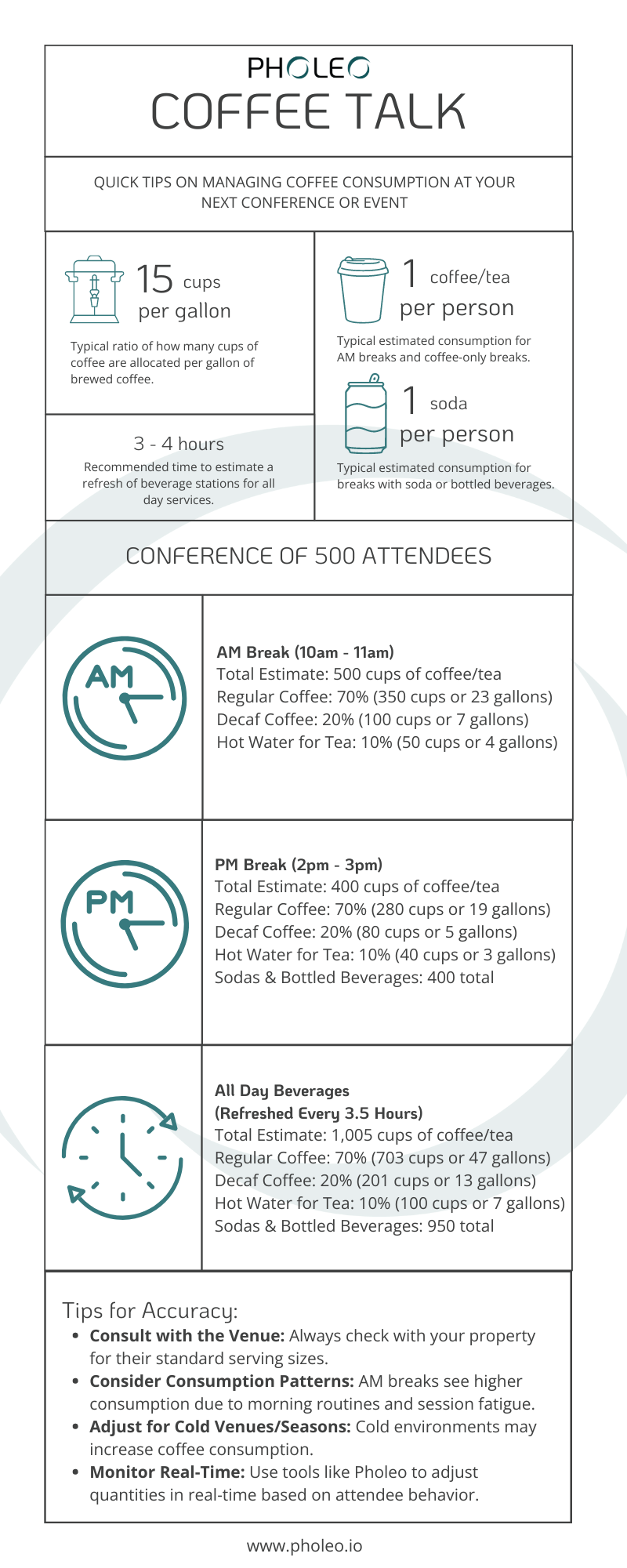
To accurately estimate coffee quantities, it’s crucial to understand the basic ratios. Typically, 1 gallon of coffee equals 15 cups. While most properties use 8oz cups, which would equate to 16 cups per gallon, estimating 15 cups provides a buffer. Always consult with your property to understand their standards, as these can vary.
Estimating Consumption: AM Breaks, PM Breaks, and All-Day Beverages
When planning for estimated consumption, consider the different types of beverage services:
-
AM Breaks: These are usually the heaviest for coffee consumption. Attendees who skip breakfast may be hungry and tired after the opening session, and a cold general session room can increase the desire for a warm beverage. Most coffee drinkers are ready for their second cup by 10 a.m. if they had their first around 8 a.m.
-
PM Breaks: Depending on the total variety of beverages available, coffee consumption may go down during PM breaks, but when looking at the cost benefit analysis of a gallon of coffee vs. soda or bottled beverages, coffee is still the more cost effective option. It is also worth noting that if sodas are offered, many attendees will take one for now, and a few for their room later (especially if you are in a market where hotel prices for soda are higher than average). If budget is a concern you may want to consider just coffee during your PM break. Our experience shows that less people will complain about not having soda available at 2p than not having coffee.
-
All-Day Beverages: If you find yourself in a budget surplus scenario, and would like to provide your attendees with all day beverages, we recommend planning a refresh every 3-4 hours. This basically doubles your consumption throughout the day broken into 3-4 hour increments. For this, it’s best to anticipate a heavier consumption during the morning hours, with lighter consumption during the lunch hour and late afternoon.
-
Breakfast & Lunch: Typically, properties include coffee in both breakfast and lunch services as part of the total package, so a la carte consumption doesn’t need to be estimated separately for these times. If you find yourself in a situation where you do have to estimate for a la carte beverage, we strongly recommend negotiating a package price, since coffee consumption will typically be higher during meal services.
A Sample Estimate:
Let’s use an AM break for a conference of 500 people for 1 hour from 10a - 11a. A good rule of thumb is to estimate at least one beverage per person during heavier consumption time periods. Here’s a breakdown for a conference with 500 attendees:
-
Total Estimate: 500 cups of coffee/tea
-
Regular Coffee: 70% (350 cups or approximately 23 gallons).
-
Decaf Coffee: 20% (100 cups or approximately 7 gallons).
-
Hot Water for Tea: 10% (50 cups or approximately 4 gallons).
To calculate the quantities:
-
Total Gallons: 500 attendees / 15 cups per gallon = 33.3 gallons (rounded down to 33 gallons).
-
Breakdown: 33 gallons * 70% = 23 gallons of regular coffee, 7 gallons of decaf, and 4 gallons of hot water.
Let’s use the same conference for 500 attendees with a PM break where sodas will be added to the available options.
-
Total Estimate: 400 cups of coffee/tea
-
Regular Coffee: 70% (280 cups or approximately 19 gallons).
-
Decaf Coffee: 20% (80 cups or approximately 5 gallons).
-
Hot Water for Tea: 10% (40 cups or approximately 3 gallons).
-
Sodas & Bottled Beverages: 400 total
And finally using the same 500 person conference, say we would like to do an all day beverage station. Since we will refresh every 3.5 hours, the equation of estimated beverages served is increased accordingly:
-
Total Estimate: 1,005 cups of coffee/tea
-
Regular Coffee: 70% (703 cups or approximately 47 gallons)
-
Decaf Coffee: 20% (201 cups or approximately 13 gallons)
-
Hot Water for Tea: 10% (100 cups or approximately 7 gallons)
-
Sodas & Bottled Beverages: 950 total
Consider Working Smarter
Managing coffee quantities and budgets manually can be time-consuming and prone to errors. This is where Pholeo's Inventory-on-the-Fly feature comes into play. Pholeo allows you to streamline and duplicate previous estimates, significantly cutting down on the manual time required to calculate AM and PM breaks.
With Pholeo, you can save commonly used products and services, such as coffee, and easily recall them for future events. This means you can quickly apply previous estimates to new events, ensuring consistency and accuracy. Additionally, Pholeo's integrated platform automatically updates quantities and costs in real-time, giving you a clear picture of your budget and consumption at any given moment.
By using Pholeo, you can focus on the more strategic aspects of event planning, knowing that the logistical details are handled efficiently. This not only saves time but also ensures that you stay within budget and provide a great experience for your attendees.
Accurately estimating coffee quantities for conferences requires understanding the ratios, consulting with your property, and planning for consumption based on attendee behavior. By following these guidelines, you can ensure that you provide enough coffee for your attendees without significantly exceeding your budget.